

- 22 April, 2026
- Announcements
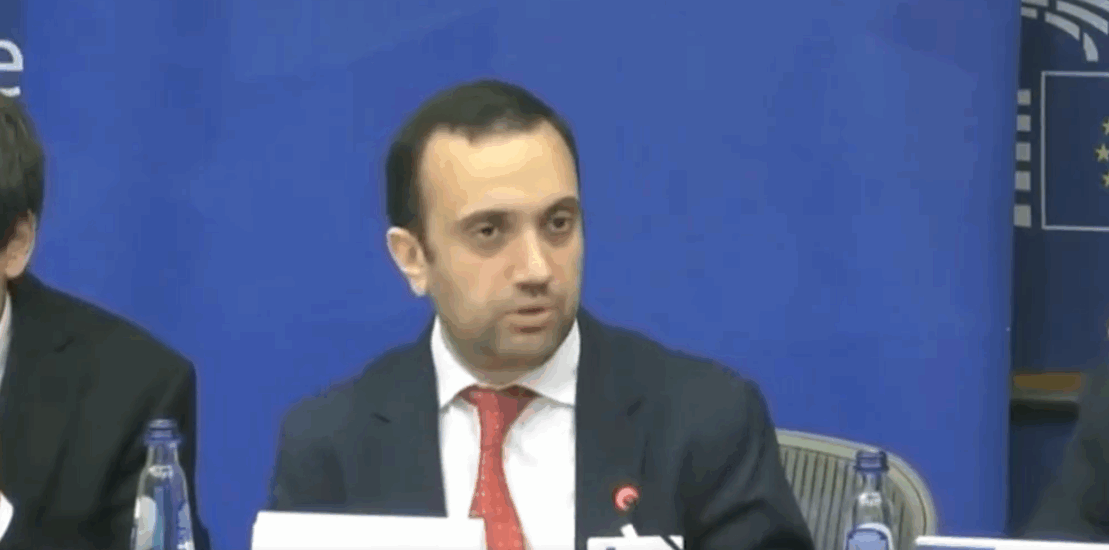
On April 21, in Brussels, during the European Parliament event titled “Hybrid Threats and Disinformation – The Role of Civil Society in Armenia’s Elections,” Program Coordinator of the “Union of Informed Citizens” NGO, Daniel Ioannisyan, presented the main manifestations of hybrid influence in Armenia’s information and media environment.
He addressed the countermeasures used by civil society, including fact-checking, monitoring of electoral processes, and public awareness campaigns.
The text of Daniel Ioannisyan’s speech is provided below:
“Thank you very much.
I should mention, adding to what Lucine said, that it may sound unusual, but in Armenia we have NGOs that perceive their role as being in opposition. Moreover, there are NGOs and media outlets which, while implementing projects aimed at countering hybrid threats, are in fact spreading those same narratives — either Russian narratives or claims denying the existence of hybrid attacks by Russia. We have observed such cases, and many of these initiatives are funded by the EU, though that is a long story.
Regarding the media environment in Armenia, I should note that Armenia is a small and not a wealthy country although not poor either. Operating an independent media outlet is extremely hard, and there is no sustainable market. As a result, media outlets require external funding. This may come from donors supporting independent journalism, but it may also come from actors with not so good intentions, which occurs quite often.
There are very few independent media outlets, and the media landscape is highly polarized, unfortunately. At the same time, we do have Russian TV channels which are still broadcast in Armenia, which remains a serious problem. While most news programs are not aired in full, this continues to pose a problem. One of our key demands from the government is the complete suspension of Russian state TV channels.
Unlike in many countries such as Moldova, Ukraine, or some Baltic states, the Russian language is not widely dominant in Armenia. Approximately 98% of the population has Armenian as their native language. While many people do speak Russian, only about 1–2% consider it their native language which is quite good compared to some other countries.
We are taking some actions to protect society from these influences mentioned by other speakers as well. One of our primary tools is fact-checking, although its impact is limited. We also monitor and count participants at public protests to prevent manipulation of attendance figures. These manipulations in Armenia are less effective as we have been doing this for more than eight years, and our data is widely trusted, since we count individuals one by one and publish verifiable evidence.
In addition, we conduct targeted awareness campaigns on a number of issues, particularly on foreign policy and elections. We are trying to explain the distinction between electoral violations and election rigging, as these are not the same and it is important for the society to know. For example, an observer entering a polling station without a badge is a violation, but it does not constitute rigging. These are different things.
We explain electoral regulations. We also seek to explain the ‘why’ question — why Russia’s doing this or that. While not all developments can be predicted, certain patterns, such as cyberattacks or false bomb reports, and many things we have seen in Moldova or Armenia, still not everything can be predicted. So, we try to explain the logic behind Russia’s actions, their motives and impact, as well as types of these actions, so that when Russia ‘surprises’ us, we can help the society understand what happened and why. This is briefly how we and our partners try to counteract these threats.
Finally, with regard to election observation, we have recently observed it transform into something we can describe as a fact-checking mission. We have received more cases of false reports on serious electoral violations than actual violations. This is the first time we have encountered such a situation over the 19 years of my experience.
Thank you”.
Related Posts:
 The statement of UIC on the number of participants in the December 22 opposition rally
 UIC statement on number of participants of the march on February 23
 EaP CSF statement on the ongoing aggression by Azerbaijan against the Republic of Armenia
 Students of Yerevan State University met with the chairperson of the Anti-Corruption Committee