- 22 October, 2025
- Eurasian Economic Union
Russia’s stricter migration laws, which came into effect in 2025, have created problems for drivers transporting goods from Armenia to Russia, putting them at risk of losing their jobs and being banned from entering the Russian Federation for several years.
Based on the decree of the President of the Russian Federation, which came into effect on January 1, 2025, the duration of stay in Russia for foreign citizens (including Armenian citizens) arriving in the Russian Federation without a visa, has been reduced to a maximum of 90 days (3 months) per calendar year, instead of the previous 180 days (6 months). This applies to citizens who do not have an employment contract or residence status in the Russian Federation.
By decree of the President of the Russian Federation, foreigners with various document-related problems were given the opportunity to legalize their residence status until April 30, 2025. Otherwise, they would appear on the list of individuals subject to deportation from the Russian Federation. Later, by a decree signed on April 28, this deadline was extended to September 10 of this year.
The mentioned changes also apply to drivers transporting goods from Armenia to Russia. There is no officially published accurate information on how many drivers have been banned from entering the Russian Federation since the new legal regulations came into effect. In an interview with Hetq on October 21, migration expert Tatevik Bezhanyan noted that out of about 130 drivers who have contacted her over the past 10 days, 50 have already been banned from entering Russia.
The Union of Informed Citizens has studied the risks and possible inconsistencies between Russia’s migration restrictions and the principles set forth in the EAEU Treaty.
Drivers’ complaints and demands
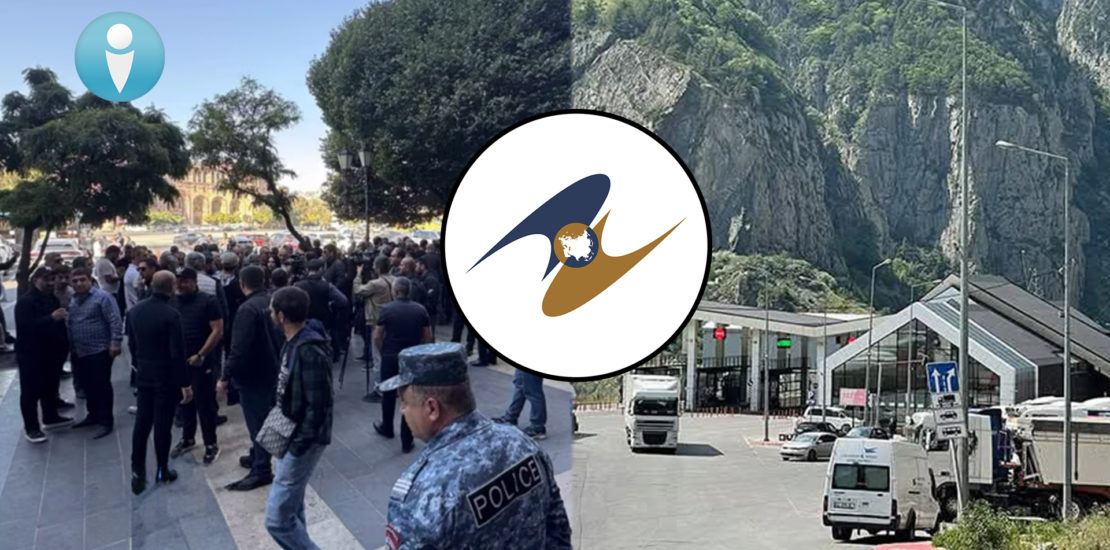
Armenian truck drivers facing the threat of a ban on entry into Russia began raising the issue in early October, first through the media and then through protests in front of the government building.
The first protest took place on October 13. The drivers had one demand from the government – to take active steps to resolve the issue. On October 16, during another protest, RA Minister of Economy Gevorg Papoyan met with drivers and acknowledged their concerns, noting: “90 days is not an option in our case, because you can spend those 90 days in Upper Lars only.”
The minister said that the issue was under discussion, but did not specify a clear timeframe for a solution.
Four days later, on October 20, drivers, who had gathered in front of the government building and the Russian embassy, declared their determination to fight, even to the point of blocking the roads with trucks. On the same evening, the media reported that drivers had blocked the roads leading to the Bagratashen, Gogavan, and Bavra checkpoints.
On October 21, the issue also became a matter of discussion in the National Assembly. In response to the MP’s question, Gevorg Papoyan stated: “The RA government has officially appealed to the Russian government, proposing that the 90 days set by domestic legislation be replaced with 180 days. Let me say in advance that we have a positive response. Russian partners have agreed with our concerns, and, according to my information, a legislative initiative aimed at solving this very problem is already in the process of internal circulation.”
The Minister informed that the issue will also be discussed at the EAEU meeting to be held on October 24, after which further information will be provided.
Russian restrictions contradict principles of the EAEU
Article 1 of the EAEU Treaty, signed on May 29, 2014, states: “Under the present Treaty Parties shall establish the Eurasian Economic Union and ensure free movement of goods, services, capital and labor as well as coordinated, agreed or common policy in the economic sectors defined in the present Treaty and in the international agreements within the EAEU.”
However, Russia’s restrictions actually hinder the free movement of goods, services, capital, and especially labor between the EAEU member states Armenia and the Russian Federation.
Article 3 of the Treaty specifies that the Union shall operate within the framework of the powers conferred on it by the Member States, based on a number of principles, including the principles of mutually beneficial cooperation, equality and the national interests of the Parties.
Note that local media in Kazakhstan report that, following bilateral negotiations, Russia is temporarily lifting the 90-day ban for the truck drivers. If this information is confirmed, it will turn out that the approach of equality between the EAEU member states is not adhered to.
A few days ago, the Armenian Ministry of Foreign Affairs also voiced concerns regarding a potential conflict between the restrictions imposed by Russia and the principles of the EAEU.
The Foreign Ministry statement shared by Azatutyun radio station states: “It is constantly emphasized that the changes contradict the principles of the EAEU, in particular, the most important principle of free movement of labor. The fundamental documents of the EAEU clearly state that citizens of all member states of the Union have equal rights, while the changes to the migration legislation, in our opinion, establish unequal conditions for citizens of other EAEU countries.”
Thus, the 90-day entry restriction to Russia not only hinders the work of Armenian freight forwarders, but also contradicts the principles of the free movement of goods, services, and labor between the EAEU member states, enshrined in the agreements.
Gayane Markosyan
Union of Informed Citizens