


- 22 April, 2026
- Announcements
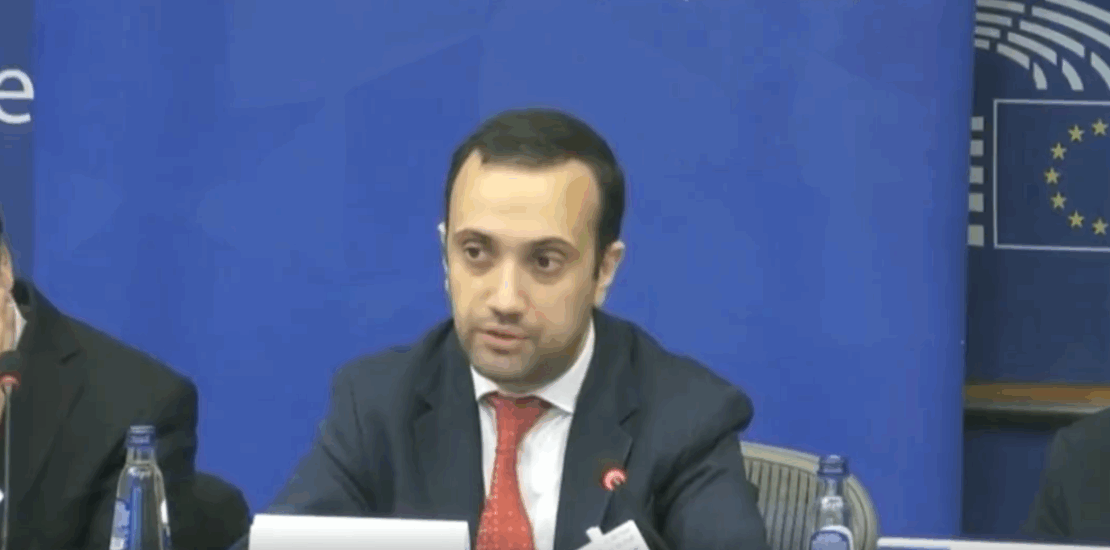
On April 21, during the event titled “Hybrid Threats and Disinformation – The Role of Civil Society in Armenia’s Elections” held at the European Parliament in Brussels, Daniel Ioannisyan, Program Coordinator of the Union of Informed Citizens NGO, delivered speeches addressing external interference in Armenia’s electoral processes, disinformation campaigns, and hybrid threats.
In his remarks, he presented both the main existing risks and the mechanisms through which they manifest, as well as the forms of influence operating within the information environment and the countermeasures employed by civil society.
The English translations of Daniel Ioannisyan’s speeches are provided below.
Speech 1
“Thank you very much, dear Members of the European Parliament, dear guests. It’s my honor to be here today.
I should say that the main threat to the upcoming elections in Armenia is Russia, if short. If long, there are many ways Russia is trying to interfere or is already interfering in elections in Armenia.
First, of course, it includes FIMI — information manipulations that Russia is conducting in Armenia’s media sphere. Russia has political actors under its control in Armenia who are quite well financed and are engaged in many illegal activities, including vote buying and other actions already seen even a couple of months ahead of the elections.
Another issue is that Russia is sending voters or holders of Armenian passports to Armenia to attend elections. This is mainly done through Armenian businessmen operating in Russia, who are forced by the FSB — the Russian law enforcement security agency — to send their employees to Armenia to vote for pro-Russian political parties, otherwise those businessmen are promised to face a lot of problems.
There are also many other tools of influence that Russia is using or may try to use, but I will not go into detail. Instead, I would like to focus on the narratives Russia is trying to spread in Armenia.
One is creating the impression that everyone is corrupt — that all officials, current or former, are equally corrupt. There are no less corrupt or non-corrupt people; everyone is corrupt and everyone is terrible.
Another is creating the impression that Armenia does not have democracy. Let’s be clear: the level of democracy in Armenia is not very high, and we are not happy with it but we do have democracy and many democratic institutions that other countries in the region do not have. Still, Russia is trying to create the impression that we do not have democracy, sometimes even suggesting that the level of democracy in Armenia is even lower than in Russia.
Another narrative is that Armenia cannot gain independence from Russia — all attempts to do so will fail and that there is no way. Within this, Russia is portrayed as being very strong, with claims that the Russian army is successful in Ukraine and not even fully engaged in the war: if it were, it could occupy Kyiv in three days or three weeks.
They also try to create the impression that many of the problems Armenia has faced in recent years are due to not having good enough relations with Russia or the Russian government. This includes manipulation of trade figures to suggest that Armenia cannot do many things without Russia, that we cannot build a new nuclear power plant or export goods if Russia closes its markets for us, etc.
Another narrative is the anti-peace narrative, which is split into several topics. One is an ideological anti-peace narrative — how can we be at peace with Azerbaijan given the past conflicts, that this is a historical issue and we should fight against them forever, and so should our grandchildren. This includes calls to take back Nagorno-Karabakh or even territories of historical Armenia from Turkey.
Another topic is opening borders and trade, creating the impression that cooperation with neighbors is dangerous and harmful. An attempt is also made to create the impression that peace means loving each other, so any hostile statements from Azerbaijan are used to argue that peace is not possible.
Another direction is creating the impression of a lack of safety. Previously, the focus was on foreign actors, but now it is more on internal safety. In reality, for more than two years — two year and two months — no one has been killed on the Armenia-Azerbaijan border, which is a significant success. However, narratives have shifted to domestic issues.
If you ask people in Yerevan how often homicides occur, many will say every day. In reality, they happen on average once a week. While this is by no means good, it is not so frequent, and the number has not changed over the past 15 years.
Regarding traditional values, Russia often uses this narrative globally, and it is also trying to do so in Armenia. However, recent clashes between the government and the leadership of the Armenian Apostolic Church have led the ruling party to take over this field. The government has pointed out that some clerics are not following the religious code of not making a family, etc., although it has also crossed certain red lines, such as publishing personal data, which is unacceptable. Still, this has limited Russia’s influence in this area.
Finally, and most importantly in the short term, Russia is trying to delegitimize the elections. This is the most dangerous aspect.
During last year’s local elections in Armenia’s second and fourth largest cities, pro-Russian groups actively tried to create the impression of rigged elections, including ballot stuffing and serious violations.
While in reality, the last recorded case of ballot stuffing in Armenia was in 2015. Even during the 2017 national elections before the Revolution, which were not fully democratic, no ballot stuffing occurred. That means such practices have not happened for more than 10 years, yet attempts are being made to suggest that ballot stuffing and vote buying are still happening.
We are trying to explain that this is far from reality. In Armenia, half of election commission members at polling stations represent the opposition. There are cameras in polling stations and many mechanisms to protect votes, some of which do not exist in other countries in the region.
For example, Armenia publishes lists of voters who participated in elections, allowing verification of whether a specific person attended the elections. While this goes against some recommendations of the Venice Commission, it is implemented to ensure greater transparency and reduce the risk of violations.
Thank you very much for your attention”.
Speech 2
«Thank you very much.
I should mention, adding to what Lucine said, that it may sound unusual, but in Armenia we have NGOs that perceive their role as being in opposition. Moreover, there are NGOs and media outlets which, while implementing projects aimed at countering hybrid threats, are in fact spreading those same narratives — either Russian narratives or claims denying the existence of hybrid attacks by Russia. We have observed such cases, and many of these initiatives are funded by the EU, though that is a long story.
Regarding the media environment in Armenia, I should note that Armenia is a small and not a wealthy country although not poor either. Operating an independent media outlet is extremely hard, and there is no sustainable market. As a result, media outlets require external funding. This may come from donors supporting independent journalism, but it may also come from actors with not so good intentions, which occurs quite often.
There are very few independent media outlets, and the media landscape is highly polarized, unfortunately. At the same time, we do have Russian TV channels which are still broadcast in Armenia, which remains a serious problem. While most news programs are not aired in full, this continues to pose a problem. One of our key demands from the government is the complete suspension of Russian state TV channels.
Unlike in many countries such as Moldova, Ukraine, or some Baltic states, the Russian language is not widely dominant in Armenia. Approximately 98% of the population has Armenian as their native language. While many people do speak Russian, only about 1–2% consider it their native language which is quite good compared to some other countries.
We are taking some actions to protect society from these influences mentioned by other speakers as well. One of our primary tools is fact-checking, although its impact is limited. We also monitor and count participants at public protests to prevent manipulation of attendance figures. These manipulations in Armenia are less effective as we have been doing this for more than eight years, and our data is widely trusted, since we count individuals one by one and publish verifiable evidence.
In addition, we conduct targeted awareness campaigns on a number of issues, particularly on foreign policy and elections. We are trying to explain the distinction between electoral violations and election rigging, as these are not the same and it is important for the society to know. For example, an observer entering a polling station without a badge is a violation, but it does not constitute rigging. These are different things.
We explain electoral regulations. We also seek to explain the ‘why’ question — why Russia’s doing this or that. While not all developments can be predicted, certain patterns, such as cyberattacks or false bomb reports, and many things we have seen in Moldova or Armenia, still not everything can be predicted. So, we try to explain the logic behind Russia’s actions, their motives and impact, as well as types of these actions, so that when Russia ‘surprises’ us, we can help the society understand what happened and why. This is briefly how we and our partners try to counteract these threats.
Finally, with regard to election observation, we have recently observed it transform into something we can describe as a fact-checking mission. We have received more cases of false reports on serious electoral violations than actual violations. This is the first time we have encountered such a situation over the 19 years of my experience.
Thank you».
Speech 3
«Thank you very much.
Honestly, it is sometimes quite difficult to build peace with a country that is far from democracy and uses anti-Armenian rhetoric to justify its power but that’s another story.
As for the participation of Nagorno-Karabakh refugees in elections, those who have applied for Armenian citizenship will be able to participate. The Migration Service is doing its best to provide citizenship as soon as possible. It is even promising that those who applied until mid-April will receive citizenship before the elections and be able to vote.
Narratives in Armenia sometimes reach quite extreme levels. Calling them “funny” is perhaps the most appropriate reaction. For example, when a newspaper head compares the Armenian government to Pol Pot’s regime in Cambodia because a criminal investigation was initiated against a breastfeeding woman—without pre-trial detention—that’s equal to Pol Pot who killed millions of people. That’s the level of discourse we have reached in Armenia.
Regarding law enforcement, reforms are progressing quite slowly. Civil society is highly engaged in these reforms, and its role is quite impactful. Almost all police officers patrolling the streets of Yerevan have passed interviews with civil society organizations. Moreover, all officers of the Anti-corruption Committee have undergone interviews with commissions involving civil society.
Civil society has also played a decisive role in high-level appointments. About a year ago, civil society organizations managed to block the candidacy of a head of the Anti-corruption Committee, even though the candidate had the support of the Prime Minister and was the only candidate. This was done through a formal vote in the commission.
Despite this engagement, reforms remain slow and there are many gaps. For example, in terms of crowd control, police capacities are still being built. There are efforts through training to improve efficiency and reduce harm to citizens, but progress is limited. There are cases where law enforcement officers struggle to carry out arrests effectively, even when dealing with individuals who are not particularly strong but are resisting. That’s a problem.
Inter-agency cooperation is also an issue. While this is a common problem globally, in Armenia agencies often operate within their own domains, and coordination is not always efficient.
Regarding intelligence services, I honestly have no idea. There is very limited public information, especially about the newly established foreign intelligence service. I don’t even know where their office is, so it’s really hard to judge. The Security Service of Armenia has undergone little reform but it is coming from Soviet times. So the efficiency of those agencies in combating the mentioned threats unfortunately remains limited.
Thank you».
Related Posts:
 The statement of UIC on the number of participants in the December 22 opposition rally
 Students of Yerevan State University met with the chairperson of the Anti-Corruption Committee
 Armenian NGOs Appeal Again to the UN Security Council
 Armenia-European Union civil society platform meeting held on December 19