- 2 April, 2026
- Foreign Policy
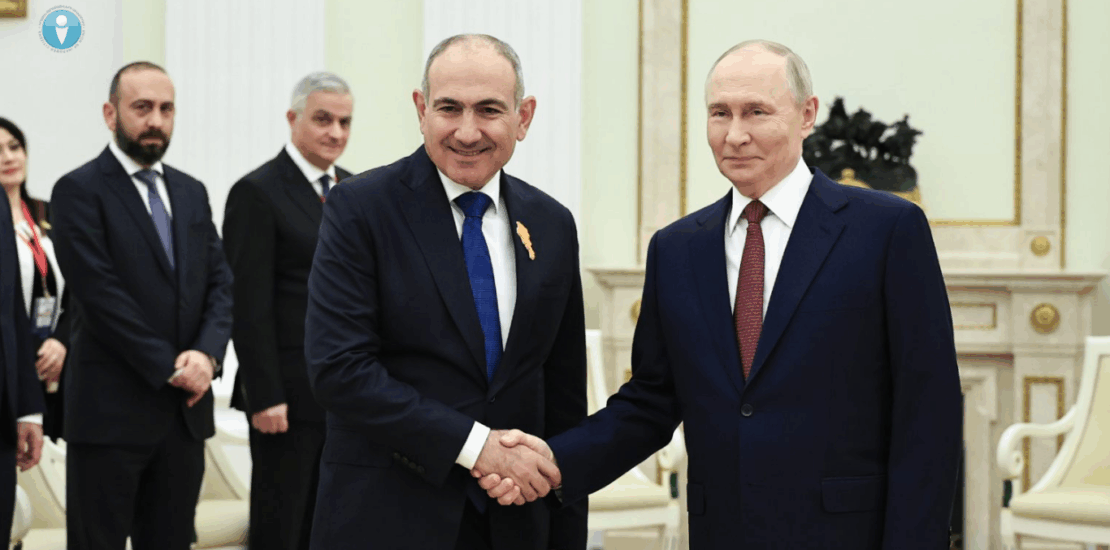
On April 1, Armenian Prime Minister Nikol Pashinyan’s visit to Moscow and his meeting with Russian President Vladimir Putin became a widely covered topic in Russian media.
Ahead of the meeting, the Kremlin press service stated that the two leaders planned to discuss the current state and future prospects of Armenian-Russian relations, as well as key items on the regional agenda, particularly the development of economic and transport links in the South Caucasus.
Nevertheless, the Putin–Pashinyan meeting — the 32nd, according to TASS — became yet another opportunity for the Russian propaganda machine to portray Armenia’s authorities as “failing” and Russia as the only indispensable “lifeline.”
Leading pro-Kremlin media outlets deployed a full range of information pressure tactics in their coverage of the meeting.
“Pashinyan in dire straits ”
“Pashinyan is heading to Moscow at a critical moment for himself,” reported NTV, emphasizing that just two months ahead of elections, “Pashinyan has found himself in dire straits: the ruling party has lost its former reputation, and another term as Prime Minister is not guaranteed.”
However, it remains unclear what this claim is based on. The most recent independent professional poll conducted in Armenia — by the International Republican Institute and published on March 6 — showed the ruling Civil Contract party in the lead (other polls have also been published, though they were commissioned by various political actors — ed.).
The report implies that Armenia’s Prime Minister turns to Moscow at a moment of domestic difficulty, reinforcing a narrative in which Russia is cast as a key “lifeline.”
The report is largely built around negative examples, highlighting public dissatisfaction, accusations related to Nagorno-Karabakh, and heated interactions with citizens — all generalized as reflecting broader public sentiment. At the same time, proposed constitutional amendments are framed as the result of foreign pressure, particularly from Azerbaijan.
The report also places particular emphasis on the role of the West, portraying it as interfering in Armenia’s internal affairs through ironic characterizations such as a “the landing force of Western political technologists” (a reference to the EU’s Hybrid Rapid Response Team — ed.).
In effect, NTV constructs a narrative in which Pashinyan is depicted as a weak leader lacking a solid political base, while Russia is presented as Armenia’s key partner, and the West is framed as an intrusive external force.
Disinformation on First Channel
A report by Russia’s First Channel Russia mentions Gyumri Mayor Vardan Ghukasyan, stating that the “politician Vardan Ghukasyan is in detention and had advocated for the creation of a Union State with Russia, following the example of Belarus.”
However, the report omits a key fact: Ghukasyan is in detention on corruption charges, and his criminal case does not carry a political element.
Another notable distortion in the same report concerns the Collective Security Treaty Organization (CSTO). The journalist claims that Armenia has frozen its membership, stopped paying contributions, and justifies this by stating that the CSTO “failed to respond adequately to the situation in Nagorno-Karabakh.”
The report then selectively quotes Prime Minister Nikol Pashinyan, citing only a fragment in which he says Armenia is not participating in CSTO activities because it cannot explain to its citizens why the Organization failed to act in line with its obligations.
Based on this partial quote, the journalist concludes that the CSTO did not intervene because Armenia had not recognized Nagorno-Karabakh’s independence, also referring to statements by Vladimir Putin.
This constitutes a clear distortion of context. Pashinyan’s remarks are presented incompletely and out of context. In reality, he was referring not to Nagorno-Karabakh, but to the CSTO’s lack of response during Azerbaijan’s military actions against Armenia’s sovereign territory in September 2022.
By conflating separate events and selectively quoting statements, the report constructs a fundamentally different narrative, altering the meaning of the original remarks and attributing causality on misleading grounds.
Putin “mediates” for Samvel Karapetyan
An article in “Moskovsky Komsomolets” analyzes the Putin–Pashinyan dialogue and interprets the underlying messages conveyed by the Russian President.
“On the eve of parliamentary elections, Putin explained the cost of a victory by pro-European forces — simultaneous membership in the Eurasian Economic Union and the European Union is impossible,” the outlet writes. According to the publication, Putin also reminded that Armenia receives Russian gas at below-market prices.
In this framing, the reference to gas pricing functions less as economic context and more as implicit pressure, while Russian media portray it as “generosity” that could be withdrawn at any time.
In effect, Putin signals the potential consequences of Armenia’s foreign policy choices, emphasizing the incompatibility of EU integration with EAEU membership.
The article also touches on possible influence over electoral processes, noting that the Russian President highlighted the importance of pro-Russian forces participating in Armenia’s parliamentary elections, including “politicians currently imprisoned,” implicitly referring to Samvel Karapetyan.
However, Karapetyan is a well-known Armenian-Russian businessman who has never been involved in politics in Armenia. Moreover, he holds citizenship of other countries, including the Russian Federation, and therefore is not eligible to participate in Armenian elections.
The publication also adopts an ironic tone in portraying Pashinyan, commenting not only on political matters but also on his attire and behavior.
Overall, “Moskovsky Komsomolets” advances a narrative in which European integration is framed as a risky choice, while Russia is depicted as a decisive actor with clear expectations regarding Armenia’s domestic political developments.
In “Kommersant”, columnist Andrey Kolesnikov, known for his ironic style, openly expresses enthusiasm about the Putin–Pashinyan meeting, describing it as notable in content, tone, and interpersonal dynamics. He further speculates that the meeting could “mark the end for one of its participants,” implying that someone — either within the government or among external actors — may lose political standing. The implication is widely understood to be directed at Pashinyan.
Notably, Yerevan Today, an outlet affiliated with Robert Kocharyan, republished the article under the headline: “Kommersant signals the beginning of the end for Pashinyan.”
Across Russian media coverage, striking similarities emerge not only in content but also in methods employed. Common techniques include:
- selective presentation of facts
- generalization of isolated cases
- use of irony to discredit individuals
- fear-based messaging through implied threats
- framing choices as mutually exclusive.
Taken together, these publications do not merely report on the Putin–Pashinyan meeting as a news event, but construct a broader narrative about Armenia’s domestic and foreign policy trajectory.
Different outlets deliver the same core messages in varying tones: Russia is portrayed as Armenia’s key partner, a guarantor of security and energy stability; the West is framed as a source of risk; and Armenia’s current authorities are depicted as vulnerable and lacking legitimacy.
This reflects not isolated publications, but a coordinated set of narratives capable of shaping public perception and influencing the political agenda.
Hasmik Hambardzumyan
Union of Informed Citizens