


- 28 July, 2026
- Elections
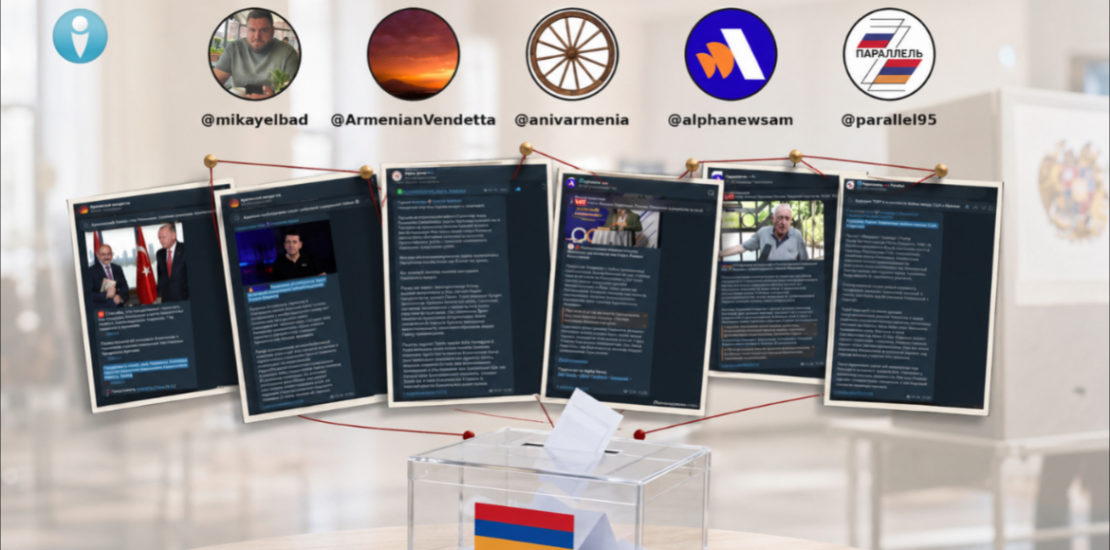
Discussion of Foreign Information Manipulation and Interference (FIMI) in Armenia began months before the parliamentary elections. Fact-checking journalists warned that democratic processes, the electoral system, and state institutions in Armenia had become targets of information operations affiliated with the Kremlin. The disinformation narratives being disseminated sought to undermine public trust in these institutions, cast doubt on the legitimacy of the elections, and create an information environment favorable to pro-Russian political forces.
In the run-up to the elections, Kremlin narratives targeting Armenian voters circulated not only through Russian state media, Armenian opposition political forces, and domestic actors, but also through Russian-language Telegram channels that regularly publish content related to Armenia.
Between May 1 and June 30, our team monitored more than 25 such Telegram channels. The study identified five channels—Mika Badalyan, “Армянская вендетта” (Armenian Vendetta), “Анив Армения” (Aniv Armenia), “Работает Альфа” (Alpha Is Working), and “Параллель” (Parallel)—that appear to have links with the Kremlin-aligned Eurasia organization.
The monitoring found that these channels disseminated identical or highly similar narratives, cited the same Russian state and Kremlin-affiliated sources, quoted the same public figures, and actively covered the election campaigns of Armenia’s opposition parties.
Eurasia and Mika Badalyan’s Channel
Among the five channels selected for monitoring, the most active was the Telegram channel of opposition activist Mika Badalyan, which has more than 32,000 followers. It is followed, in terms of audience size and activity, by Armenian Vendetta, Aniv Armenia, Alpha is Working, and Parallel.
Mika Badalyan is also a member of the board of the Eurasia NGO, a public organization operating in several post-Soviet countries. Eurasia launched its activities in Armenia in 2024. At the time, Badalyan stated that:
“The authorities of certain countries, including Armenia and Moldova, are acting against the interests of their own citizens.”
According to him, the organization seeks to demonstrate the Armenian people’s genuine attitude toward the other peoples of Eurasia and to show Russia that there is no hostility between ordinary people.
Badalyan is currently involved in several criminal proceedings in Armenia. Most recently, public criminal prosecution was initiated against him over allegations of vote buying, specifically for promising services and other advantages to hundreds of Armenian citizens residing in Russia on the condition that they travel to Armenia to participate in the parliamentary elections.
Badalyan denies the accusations. However, prior to the elections, he repeatedly announced publicly on his Telegram channel that he was prepared to provide financial assistance to Armenian citizens living in Russia so they could travel to Armenia and vote.
Approximately one month before the elections, Badalyan began intensively disseminating several narratives through his Telegram channel that constitute examples of foreign information manipulation and interference, with the apparent aim of influencing the outcome of the parliamentary elections.
These narratives frequently sought to discredit the incumbent authorities by accusing them of treason, serving foreign interests, acting against Armenian identity, and leading Armenia toward destruction.
“Western Azerbaijan” and the loss of sovereignty
One of the most frequently promoted themes on Mika Badalyan’s Telegram channel was the narrative of “Western Azerbaijan.” Badalyan repeatedly returned to the topic, reposting content from other Kremlin-linked pages, commentary by political analysts and commentators, as well as statements made by Armenian opposition figures.
Within this narrative, the TRIPP project was portrayed as synonymous with both the “Zangezur Corridor” and the eventual loss of Meghri and the Syunik Province. Parliamentary elections, in turn, were framed as a decisive choice that would determine whether Armenia would remain a sovereign state.
The author presented Baku’s “Western Azerbaijan“ narrative as the inevitable consequence of the policies pursued by Armenia’s incumbent authorities.
“We are choosing whether we will live in Armenia or in Western Azerbaijan,” Badalyan wrote in the caption of an AI-generated video on the same topic.
Posts on the channel consistently cultivated the perception that the re-election of the incumbent government would be tantamount to the loss of Armenia’s sovereignty and territory.
“Western Azerbaijan” and “Loss of Sovereignty”: The Dominant Narratives
To foster fear and uncertainty among voters, the monitored channels regularly promoted the possibility of Armenia’s “Ukrainianization,” or the repetition of a “Moldovan” or “Georgian” scenario. To substantiate these claims, the Telegram channels frequently quoted individuals presented as “reputable” analysts and political commentators.
At the same time, existing or potential economic restrictions imposed by Russia on Armenia were portrayed not as instruments of political pressure, but rather as the natural consequence of Prime Minister Nikol Pashinyan’s political line.
Likewise, Armenia’s path toward the European Union was depicted as a deception that would ultimately result in the country’s loss of sovereignty in favor of both the West and Baku.
Thus, the monitored Telegram channels consistently presented Armenians with a binary choice: maintain relations with Russia or face war (the “Ukrainianization” scenario), economic hardship, domestic instability, and territorial losses.
The “Rigged Elections” Narrative Before and After the Vote
Another dominant narrative across the monitored channels was the allegation of imminent electoral fraud. Notably, the same actors were already claiming before the election that the vote would be illegitimate and its results falsified.
In this context, Moldova was frequently cited as an example. The channels claimed that the country’s incumbent authorities had twice lost elections but had nevertheless remained in power through electoral fraud.
In a video message, Badalyan stated:
“There will, of course, be fraud (ed. note: in Armenia), but it is not limitless. If each of you participates in the elections, then that fraud will no longer matter.”
Accusations that the Armenian authorities had manipulated the elections intensified sharply after June 7. Through Mika Badalyan’s channel and the other monitored Telegram channels, numerous posts questioned both the work of the Central Electoral Commission and the official election results.
As a result, distrust in the legitimacy of the elections was cultivated before the vote, and after the results were announced, the same narrative was used to cast doubt on the integrity of the entire electoral process.
The Church, the Family, and Armenian Identity
The monitored channels also claimed that the ruling Civil Contract party was waging a campaign against Armenian identity, targeting the Church, the family, and the Christian faith.
These issues were consistently presented as interconnected elements of a single policy directed against Armenia’s national identity.
The Church, national identity, and the traditional family were transformed into instruments of emotional mobilization. Through these themes, the channels sought to persuade audiences that voters were not merely choosing between competing political parties, but deciding whether Armenian identity itself would be preserved or lost.
Extensive Coverage of Opposition Forces
The activity of the other four monitored channels – “Армянская вендетта” (Armenian Vendetta), “Анив Армения” (Aniv Armenia), “Работает Альфа” (Alpha Is Working), and “Параллель” (Parallel) – followed a similar pattern.
These channels systemically disseminated analyses and commentary issued by the Russian Ministry of Foreign Affairs, other Russian government agencies, Russian state media outlets, Kremlin-affiliated political commentators, journalists, and bloggers concerning Armenia’s domestic and foreign policy.
Throughout the monitoring period, all five channels intensively covered the election campaigns of three opposition political forces – Strong Armenia, the Hayastan Alliance, and Prosperous Armenia – quoting interviews and public statements by their leaders and representatives.
The channels also served as information platforms for these opposition groups, publishing the dates, times, and locations of their campaign rallies.
At the same time, the overwhelming majority of posts concerning the incumbent authorities were negative in tone and focused on narratives of treason, loss of sovereignty, electoral fraud, and an assault on Armenian national identity.
The monitoring showed that the content disseminated across all five channels frequently overlapped. They promoted the same core narratives, relied on the same primary sources and the same influencers – including Armenian and Russian officials, bloggers, and journalists.
Claims of Western Interference in the Elections
The monitored channels also regularly alleged that the West was interfering in Armenia’s elections. This narrative functioned as a counterweight to accusations that Russia itself might be interfering in the electoral process.
On election day, all of these channels (1,2,3,4) circulated a translated article originally published by Russia Today (RT) – one of the Kremlin’s principal propaganda outlets. The article claimed that French intelligence agencies were helping suppress publications critical of Prime Minister Nikol Pashinyan.
The article, however, failed to explain how or by what means this was allegedly being carried out.
“According to the publication, employees of France’s VIGINUM digital security unit monitor and block online posts that contradict Yerevan’s official position,” Russia Today wrote, claiming that the report had originally appeared in the French weekly Le Journal du Dimanche.
However, the hyperlink provided on RT’s website directed readers to an entirely different Le Journal du Dimanche article about Armenia’s parliamentary elections, titled:
“Armenia’s Election Campaign Ends in a Tense Atmosphere Ahead of Parliamentary Elections.”
That article, however, contains no such allegations.
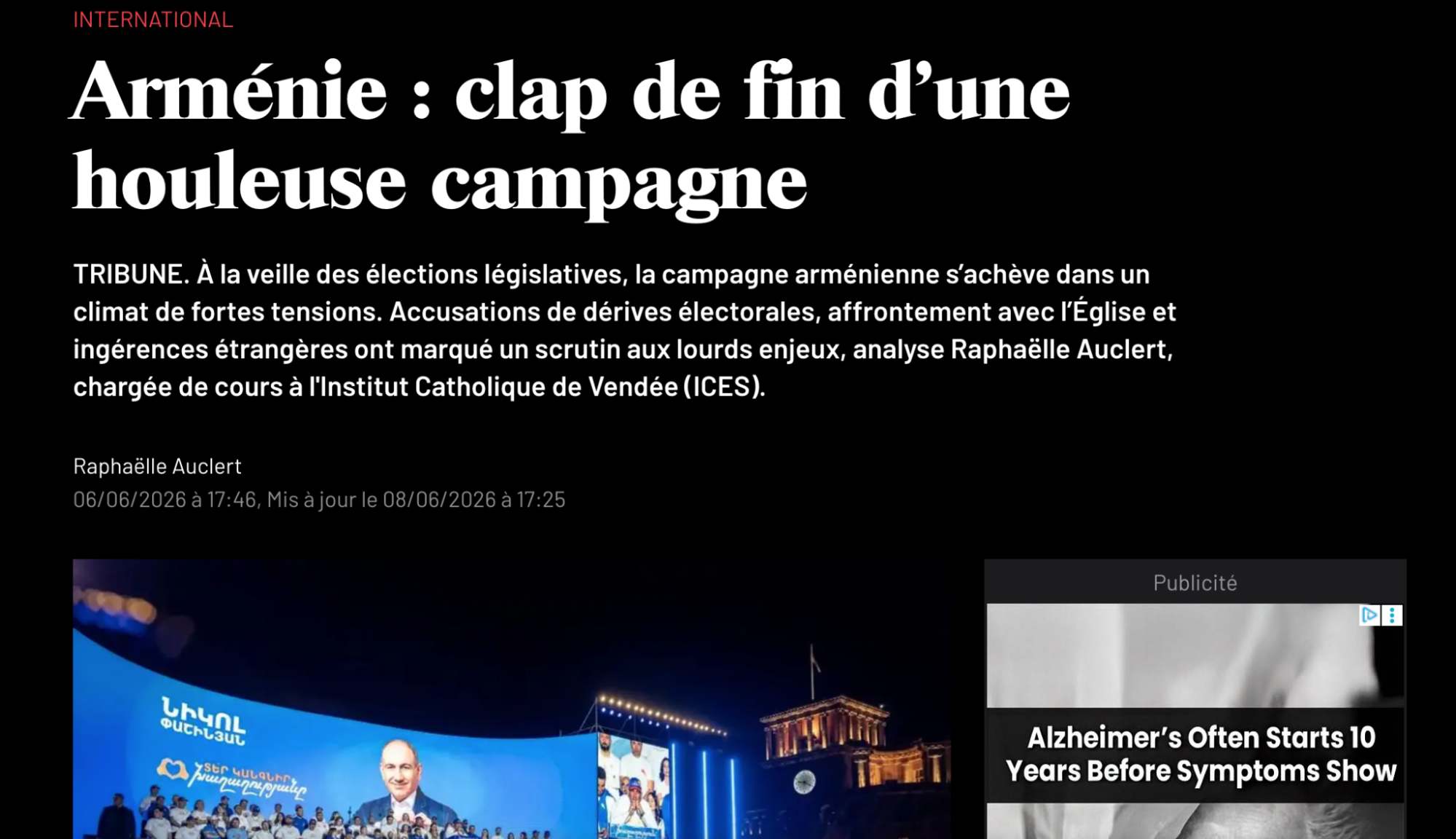
Armenia’s Election Campaign Ends in a Tense Atmosphere Ahead of Parliamentary Elections, Le Journal du Dimanche
Our investigation found that no article containing RT’s claims exists in Le Journal du Dimanche.
Instead, the original source was the English-language website easternherald.com, an outlet of unknown origin that imitates established Western media publications. That website, in turn, falsely cited Le Journal du Dimanche as the original source of the information.
Despite the fact that neither the source nor the substance of the claim could be verified, it was republished almost verbatim by a number of Armenian media outlets, including arminfo.info, Hraparak, Sputnik Armenia, alphanews.am, ArmeniaToday.
This case illustrates how an unverified claim published on a website of unknown origin was able to spread throughout Armenia’s information space via a Russian state media outlet, Telegram channels, and local media organizations.
Same sources, same influencers
The five monitored Telegram channels not only shared or reposted similar information but also consistently cited the same Armenian media outlets.
Among them were Yerevan Today, which is associated with Armenia’s second president Robert Kocharyan, as well as Channel 5 and Alpha News.
The influencers across these channels included Arman Abovyan of the Prosperous Armenia Party, self-described media expert Tigran Kocharyan, pro-Russian political analysts Benyamin Matevosyan and Artur Khachikyan, among others.
Representatives of Russian state institutions were also featured in this list. The most frequently quoted was Maria Zakharova, the official Spokesperson for the Russian Ministry of Foreign Affairs, who repeatedly accused the West of interfering in Armenia’s domestic affairs and electoral process.
Three days after the elections, Zakharova stated:
“Armenia’s parliamentary elections took place under unprecedented pressure on the opposition and amid Western interference.”
The Narrative of “Losing Digital Sovereignty”
In addition to the numerous posts questioning the legitimacy of the elections, the Telegram channels generated considerable attention toward an agreement concluded between Telecom Armenia and AzerTelecom.
Under the agreement, the Azerbaijani side would be able to use Telecom Armenia’s infrastructure to provide internet connectivity between mainland Azerbaijan and the Nakhchivan Autonomous Republic.
Tigran Kocharyan, Editor-in-Chief of Alpha News, portrayed the agreement as ceding Armenia’s digital sovereignty to Azerbaijan.
“Routing traffic through Azerbaijan gives its intelligence services the technical capability to collect metadata from Armenian users, analyze the structure of information flows within the public sector, and carry out dangerous data interception attacks. Moreover, Baku acquires a powerful digital kill switch,“ Kocharyan claimed.
However, Team Telecom Armenia refuted these claims, emphasizing that Azerbaijan would gain access only to the communications infrastructure, not to Armenian data.
“We are not selling any Armenian data to them; we are not selling them anything originating from Armenia. We are simply allowing them to use our communication line as a route from Point A to Point B so they can establish connectivity between Nakhchivan and Azerbaijan, and vice versa,” Aram Barseghyan, Deputy CEO of Telecom Armenia, told Radio Liberty.
Nevertheless, within the monitored Telegram channels, the agreement was incorporated into the already established broader narrative that Armenia’s sovereignty was being ceded to Azerbaijan.
Thus, during the period from May 1 to June 30, all five monitored Telegram channels – Mika Badalyan, Armenian Vendetta), Aniv Armenia, Alpha Is Working, and Parallel) – simultaneously and in a coordinated manner disseminated virtually identical narratives, relied on the same sources, and amplified the same political and media actors.
The publications centered on issues particularly sensitive to Armenian society, including national security, territorial integrity, the Church, and national identity. Alongside these themes, they promoted fears of destabilization, war, economic restrictions, and the loss of sovereignty.
The substantial overlap in both the content and timing of the publications across the five channels points to the existence of a coordinated information ecosystem. Its apparent objective was to discredit the incumbent authorities, increase the visibility of opposition political forces, and erode public trust in both the elections and Armenia’s state institutions.
Union of Informed Citizens
The featured image was generated by AI
Related Posts:
 Social Rights in the New Constitution Draft
 Statement
 ՀՀ ԱԺ ընտրությունների երկարաժամկետ դիտարկման միջանկյալ զեկույց: 2017թ. մարտի 5-20: «Անկախ դիտորդ» հասարակական դաշինք Ամբողջական հոդվածը կարող եք կարդալ այստեղ՝ http://hcav.am/publications/21-03-2017-03/ © 1998-2016 Հելսինկյան Քաղաքացիական Ասամբլեայի Վանաձորի գրասենյակ
 A Serious Blow to the Image of Nagorno Karabakh